

Key Takeaways
- Claude AI for marketing helps you handle content, analysis, and planning in one place using structured prompts and context.
- Learning how to use Claude AI for marketing starts with clear instructions. Better input leads to better output.
- Compared to tools like ChatGPT, Claude performs better for tasks that require depth, structure, and consistency.
- Claude AI marketing prompts work best when they include role, context, task, and output format.
- AI tools for marketing are most effective when combined with human review. They support decisions but do not replace strategy.
- AI marketing automation with Claude is built through reusable prompts and workflows, not complex systems.
- The best approach is to start with one use case, refine your process, and build a repeatable workflow over time.
Marketing today is not limited by ideas. It is limited by time and execution. Writing content, analyzing data, testing campaigns, and keeping everything consistent takes effort. This is where AI is starting to play a practical role.
Many marketers are now exploring AI tools for marketing to reduce manual work and improve output. Among these tools, Claude AI for marketing has gained attention for a simple reason. It does more than generate text. It understands context, processes large inputs, and gives structured results that you can actually use.
If you have been trying to figure out how to use Claude AI for marketing, you are not alone. The tool looks simple at first, but its real value shows when you use it with the right approach and prompts.
In this guide, you will learn how to use Claude in real marketing tasks. From content creation to automation, everything is explained in a practical way so you can apply it without confusion.
What is Claude AI for Marketing?
Claude AI for marketing means using Claude AI to handle common marketing tasks such as content writing, customer analysis, campaign planning, and workflow automation.
In simple terms, it works like a thinking assistant. You give it context, instructions, and a goal. It processes the input and returns structured output that you can use directly in your work.
If you want to understand how to use Claude AI for marketing, start with what makes it different from basic AI tools and how prompt engineering techniques shape the output.
Most tools generate quick answers. Claude focuses on:
- Understanding long inputs like documents or research data
- Following detailed instructions without losing context
- Producing organized outputs such as briefs, tables, and frameworks
- Matching tone based on your brand guidelines
This makes Claude AI for marketing useful for tasks that require clarity and consistency, not just speed.
For example, instead of asking for a blog outline, you can give Claude your audience details, competitors, and goals. It can return a full content brief with structure, keywords, and messaging.
That is the real shift. You are not just generating content. You are building complete marketing workflows using AI.
As you move ahead, you will see how this applies across different marketing tasks and where it fits in your overall process.
Why Marketers Are Turning to AI Tools Like Claude?
Marketing has always required effort across multiple areas. You write content, study your audience, test campaigns, and track results. Each task takes time, and when you try to scale, the workload increases fast.
This is why many teams now rely on AI tools for marketing as part of their broader digital marketing strategies. This is why many teams now rely on AI tools for marketing. These tools help reduce manual work while keeping output consistent. Instead of starting from scratch every time, you can move faster with better direction.
What makes Claude AI for marketing different is how it handles thinking-heavy tasks. It does not just generate text. It processes context and gives structured responses that fit your goal.
Faster Content Creation Without Losing Quality
Creating content regularly is one of the biggest challenges in marketing. Blog posts, emails, landing pages, and ads all need attention.
With Claude AI for marketing, you can generate structured drafts that already follow a clear flow. This reduces the time spent rewriting and helps you maintain a consistent tone across different formats. Instead of starting from a blank page, you begin with a usable draft and refine it.
Better Understanding of Customer Insights
Customer feedback often remains underused because it takes time to analyze. Reviews, comments, and survey responses contain useful information, but going through them manually is slow.
Claude can process large sets of feedback and highlight common patterns. It identifies recurring problems, groups similar responses, and surfaces the exact language customers use. If you want to understand how to use Claude AI for marketing, this is one of the most practical applications.
Smarter Campaign Testing
Testing different messaging is important for improving performance. The challenge is creating enough variations without spending too much time.
Claude helps you generate multiple versions of ad copy with different angles. You can quickly test different approaches and see what connects with your audience. This makes experimentation faster and more structured.
Improved Email and Funnel Workflows
Email sequences need to feel connected and purposeful. Writing them manually for each audience segment can be time-consuming.
Using Claude AI for marketing, you can create complete email flows with a clear progression. The tone stays consistent and the messaging remains aligned with your goal. This makes your communication more effective without adding extra effort.
Turning Data Into Actionable Insights
Marketing data only becomes useful when you can act on it. Reports often show numbers but not clear direction.
Claude helps break down information into simple insights. It highlights patterns and suggests what actions to take next. Instead of guessing, you make decisions based on structured input.
Supporting Decision-Making, Not Just Execution
Most tools focus on execution. Claude supports thinking.
When you use Claude AI for marketing, you are not just generating content. You are organizing ideas, refining strategy, and improving clarity before execution. This is what makes it valuable for modern marketing workflows.
Where AI Fits in Marketing Right Now
Most marketing teams already use some form of automation. Email sequences run on triggers, social posts get scheduled in advance, and CRM tools manage customer journeys. These systems handle repetitive tasks well.
What AI tools for marketing add is a layer of intelligence on top of this setup.
Automation follows rules. AI adapts based on context, which is also the core idea behind agentic AI systems.
This is where Claude AI for marketing fits in. It does not replace your existing tools. It improves how you use them.
Automation vs Intelligence
Traditional marketing automation works on fixed conditions. For example, if a user signs up, they receive a predefined email sequence. The system follows the same path every time.
Claude works differently. It processes input and adjusts output based on context. If you give it customer data, campaign goals, and brand guidelines, it responds with content that fits that specific situation.
If you are exploring how to use Claude AI for marketing, think of it as the layer that sits between raw data and execution.
Bridging the Gap Between Data and Action
Most teams collect data but struggle to use it effectively. Reports, analytics, and feedback often stay unused because they require time to interpret.
Claude helps bridge this gap. You can input large amounts of information and ask for clear direction. Instead of going through everything manually, you get structured insights that guide your next steps.
This makes decision-making faster and more focused.
Enhancing Existing Marketing Tools
Claude does not replace your CRM, email platform, or analytics tools. It works alongside them.
For example, you can:
- Pull customer data from your CRM
- Ask Claude to analyze patterns
- Use the output to refine your campaigns
This creates a smoother workflow where each tool supports the other.
A Practical Way to Think About It
Automation handles repetition. Claude handles complexity.
When you combine both, your workflow becomes more efficient. Routine tasks continue running in the background, while Claude helps you improve strategy, messaging, and execution.
As you move forward, it becomes easier to see how Claude AI for marketing applies across different tasks. The next section focuses on real use cases and how marketers are using it in day-to-day work.
What Marketers Are Actually Using Claude AI For
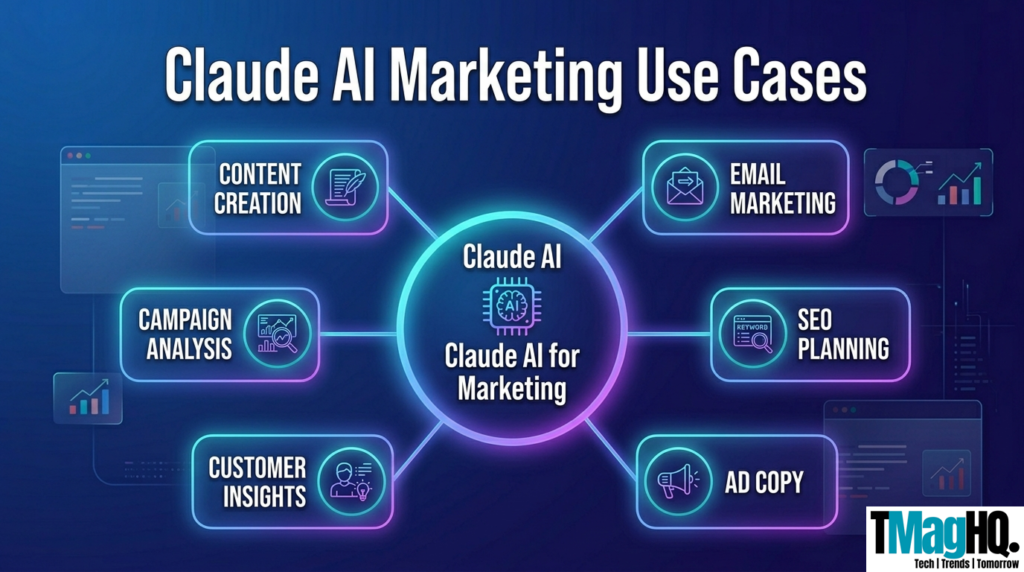
Once you understand where it fits, the next step is to see how it works in real tasks. Most use cases of Claude AI for marketing are practical and easy to apply, especially as more people explore how non-coders are building apps with AI. You do not need complex setups. You need the right inputs.
If you are learning how to use Claude AI for marketing, these are the areas where it delivers the most value.
Content Creation with Structure and Consistency
Creating content is one of the most time-consuming parts of marketing. It is not just about writing. You need structure, clarity, and alignment with your audience.
With Claude AI for marketing, you can generate content that already follows a logical flow. Instead of rough drafts, you get structured outputs like outlines, briefs, or full drafts. This reduces editing time and keeps your messaging consistent across formats.
Customer Feedback and Review Analysis
Customer insights shape better marketing, but analyzing feedback manually takes time. Reviews often contain patterns that are easy to miss.
Claude can process large sets of feedback and highlight key themes. It identifies common problems, repeated phrases, and important product mentions. This helps you understand what matters to your audience and adjust your messaging accordingly.
Ad Copy and Messaging Variations
Testing different messaging is important for improving campaign performance. The challenge is creating enough variations without slowing down your workflow.
Claude helps generate multiple versions of ad copy based on different angles. You can test different approaches quickly and see what resonates. This makes campaign testing more efficient.
Email Sequences and Funnel Content
Email marketing requires a clear flow from one message to the next. Each email should build on the previous one while guiding the reader toward action.
Using Claude AI for marketing, you can create full email sequences with a consistent tone and structure. This makes it easier to manage funnels without rewriting each email from scratch.
Keyword Clustering and SEO Planning
SEO requires organizing keywords based on intent and relevance. Doing this manually can take time, especially with large keyword lists.
Claude can group keywords into clusters and suggest which ones to prioritize. This supports content planning and helps you focus on topics that align with user intent.
Campaign Analysis and Insight Extraction
After running campaigns, you need to understand what worked and what did not. Raw data alone does not provide clear answers.
Claude helps break down campaign data into simple insights. It highlights patterns and suggests areas for improvement. This makes your next steps clearer and more focused.
These use cases show that Claude AI for marketing is not limited to one task. It supports different parts of the workflow, from planning to execution. The next step is to compare it with other tools and understand where it performs better.
Claude AI for Marketing vs Other AI Tools
Not all AI tools for content creators work in the same way. Some focus on speed, others on integration, and a few are built for deeper thinking. Understanding this difference is important if you want to use the right tool for the right task.
Claude AI for marketing stands out because it focuses on context and structured output. It performs best when the task involves large inputs, detailed instructions, or the need to maintain a consistent tone.
Claude vs ChatGPT
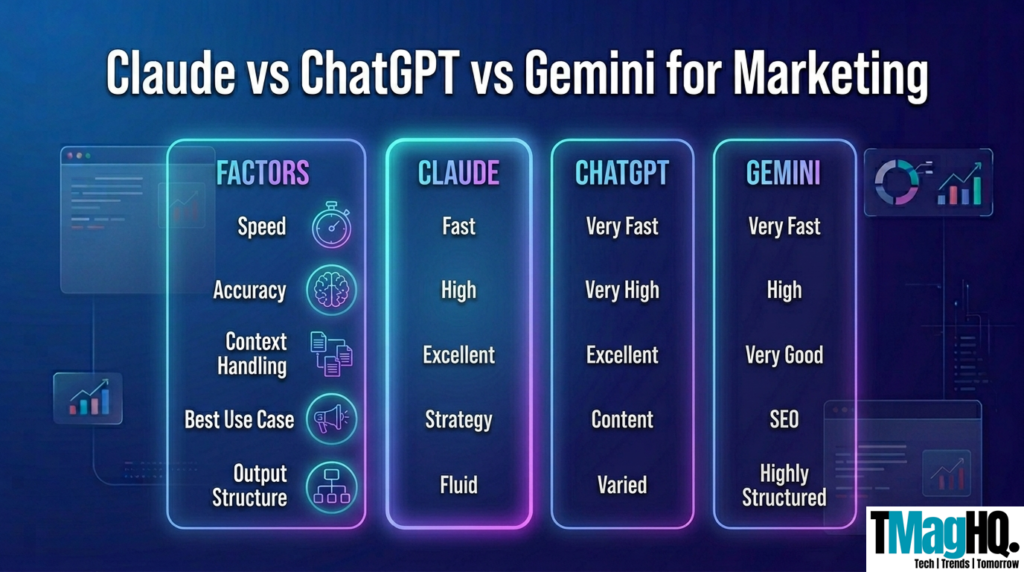
ChatGPT is one of the most widely used tools today, and understanding a full Claude vs ChatGPT comparison helps clarify where each tool performs best. It is fast and works well for brainstorming, short-form content, and quick drafts. If you need ideas or rough content quickly, it does the job efficiently.
However, when tasks become more detailed, the difference becomes clear. Claude AI for marketing handles long inputs more effectively. You can provide full documents, brand guidelines, and multiple instructions in one go. The output remains structured and aligned with your input.
Another key difference is consistency. Claude follows tone and formatting more closely, which makes it useful for content that needs to match a specific brand voice.
Claude vs Gemini
Gemini is designed to work smoothly with Google tools. It fits well into workflows that depend on Docs, Sheets, or Gmail. This makes it convenient for teams already using Google products.
Claude takes a different approach. It focuses less on integration and more on handling complex tasks. When you need to analyze large amounts of information or generate detailed outputs, Claude performs more reliably.
For example, if you input customer feedback, campaign notes, and content goals together, Claude can process everything and return a structured response. This makes it useful for planning and analysis rather than just execution.
Where Claude Fits Best
If you are learning how to use Claude AI for marketing, the key is to understand where it adds the most value.
Claude works best when:
- the task involves a lot of context
- you need structured output instead of raw text
- consistency matters across content
It may not always be the fastest option, but it reduces the need for repeated editing and adjustments.
Choosing the Right Tool for the Task
Most marketers do not rely on a single tool. Instead, they combine tools based on their strengths.
You might use ChatGPT to explore ideas quickly, Gemini for workflows inside Google tools, and Claude AI for marketing when the task requires deeper thinking and clarity.
This approach gives you flexibility while improving the quality of your output.
As you move forward, it becomes important to look at both strengths and limitations. The next section breaks down the pros and cons of Claude AI for marketing so you can use it more effectively in your workflow.
Pros and Cons of Claude AI for Marketing
Before you start using any tool regularly, it helps to understand both its strengths and its limits. The same applies to Claude AI for marketing. It performs well in many areas, but it is not designed for everything.
Strengths of Claude AI for Marketing
One of the biggest advantages of Claude AI for marketing is how well it handles context. You can provide detailed inputs such as brand guidelines, research notes, or campaign data, and it keeps everything aligned in the output. This reduces the need to repeat instructions again and again.
It also stands out for the way it organizes information. Instead of scattered responses, you get structured outputs that are easier to use in real workflows.
Key strengths include:
- Strong context handling
Claude can process large inputs like documents, feedback, and research without losing track of instructions.
- Structured and usable output
It delivers content in formats like briefs, tables, and step-based responses that you can use directly.
- Consistent brand voice
Once you define tone and style, Claude maintains it across different types of content.
- Better reliability
It avoids overconfident responses and stays closer to the information provided.
Limitations You Should Be Aware Of
While Claude AI for marketing is effective for detailed tasks, it is not always the best option for quick or lightweight work.
It also depends on how clearly you give instructions. The better your input, the better the output.
Some limitations to keep in mind:
- Slower for quick tasks
Compared to some tools, it may take more time for simple outputs or brainstorming.
- Prompt quality matters
If your instructions are unclear, the response may not meet your expectations.
- Fewer direct integrations
It does not connect as deeply with other tools out of the box, so workflows may need manual setup.
What This Means in Practice
If you are exploring how to use Claude AI for marketing, focus on tasks where depth and clarity matter more than speed. It works best for planning, analysis, and structured content creation.
Understanding these strengths and limitations helps you use the tool more effectively instead of expecting it to handle every type of task.
The next section moves into practical application, where you will see Claude AI marketing prompts that you can use directly in your workflow.
Claude AI Marketing Prompts You Can Use Today
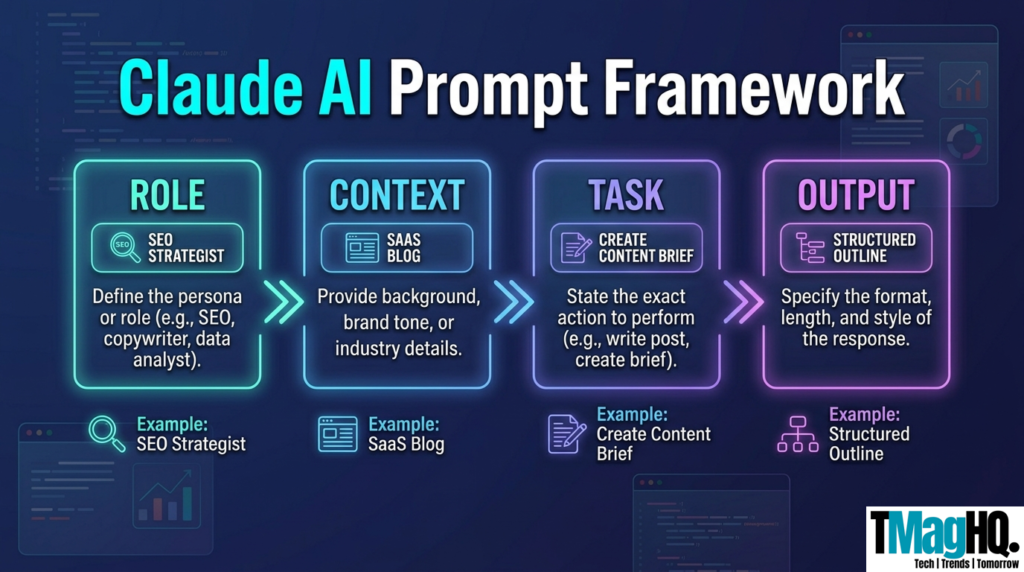
If you want to understand how to use Claude AI for marketing, you need to focus on how you write prompts. Simple prompts give average results. Detailed prompts give usable output.
Strong Claude AI marketing prompts include principles similar to prompt engineering vs AI courses discussions:
- clear business context
- audience details
- constraints
- expected format
Below are improved examples that reflect real marketing use.
Content Brief Creation (SEO-Focused)
Instead of asking for a basic outline, guide Claude with clear inputs.
Prompt:
“You are an SEO strategist. I run a [business type] targeting [audience]. The topic is ‘[topic]’. My top competitors are [URLs or names].
Create a detailed content brief that includes:
- primary keyword and 5–7 secondary keywords
- search intent breakdown
- recommended article structure (H2, H3)
- key points competitors are covering
- content gaps we can target
- suggested CTA based on user intent
Keep the output structured and ready for a writer.”
This type of Claude AI marketing prompts helps you create content that is aligned with search intent, not just keywords.
Customer Review Mining for Messaging
Instead of summarizing reviews, extract insights you can use directly.
Prompt:
“I am sharing customer reviews for [product/service].
Analyze them and return:
- Top 3 emotional pain points before purchase
- Exact phrases customers use to describe success
- Most mentioned product features
- Any objections or concerns mentioned
Format the output as a table with headings and short explanations.”
With Claude AI for marketing, this helps you build messaging that reflects real customer language.
Email Sequence with Conversion Goal
Avoid generic email writing. Define purpose and flow clearly.
Prompt:
“Act as an email marketing strategist.
Write a 5-email onboarding sequence for [product/service].
Audience: [describe]. Goal: convert free users into paid customers.
Structure:
- Email 1: Welcome and brand introduction
- Email 2: Highlight key problem and solution
- Email 3: Share proof or example
- Email 4: Address objections
- Email 5: Strong CTA
Each email should include subject line, preview text, and body under 150 words. Keep tone [describe].”
This approach makes Claude AI for marketing outputs more aligned with funnel stages.
Ad Copy Based on Psychological Angles
Basic prompts create repetitive ads. Better prompts create distinct variations.
Prompt:
“Our product is [X]. Target audience is [Y].
Create 5 ad variations, each based on a different angle:
- fear of missing out
- social proof
- transformation
- direct benefit
- problem-solution
Each variation should include a headline and body under 80 words. Avoid generic phrases. Focus on clarity and specificity.”
These Claude AI marketing prompts help you test meaningful variations, not just reworded versions.
Keyword Clustering with Intent Mapping
Instead of grouping keywords randomly, connect them to strategy.
Prompt:
“I am providing a list of keywords related to [topic].
Group them based on:
- search intent (informational, commercial, transactional)
- funnel stage (awareness, consideration, decision)
Then suggest:
- top 5 keywords to prioritize
- content ideas for each cluster
- internal linking suggestions
Keep the output structured.”
This is where how to use Claude AI for marketing connects directly with SEO planning.
Campaign Analysis and Improvement
Use Claude to interpret performance data, not just summarize it.
Prompt:
“Here is campaign data from [platform].
Analyze it and provide:
- key performance insights
- patterns or trends
- underperforming areas
- 3 clear recommendations for improvement
Keep explanations simple and actionable.”
This turns raw data into decisions you can act on.
How to Improve Your Prompts Over Time
The more you use Claude AI for marketing, the better your prompts become. You start noticing what kind of inputs lead to better outputs.
Focus on:
- adding more context
- defining clear outcomes
- specifying output format
Save your best-performing prompts. Over time, this becomes a reusable system that improves both speed and quality.
These examples show that strong Claude AI marketing prompts are not complex, but they are detailed and purposeful. The next section will walk through the exact steps to apply this in your workflow.
How to Use Claude AI for Marketing (Step-by-Step)
Now that you have seen practical prompts, the next step is to build a simple workflow. Understanding how to use Claude AI for marketing is less about tools and more about how you structure your process.
You do not need a complex setup. You need a clear starting point and a repeatable approach.
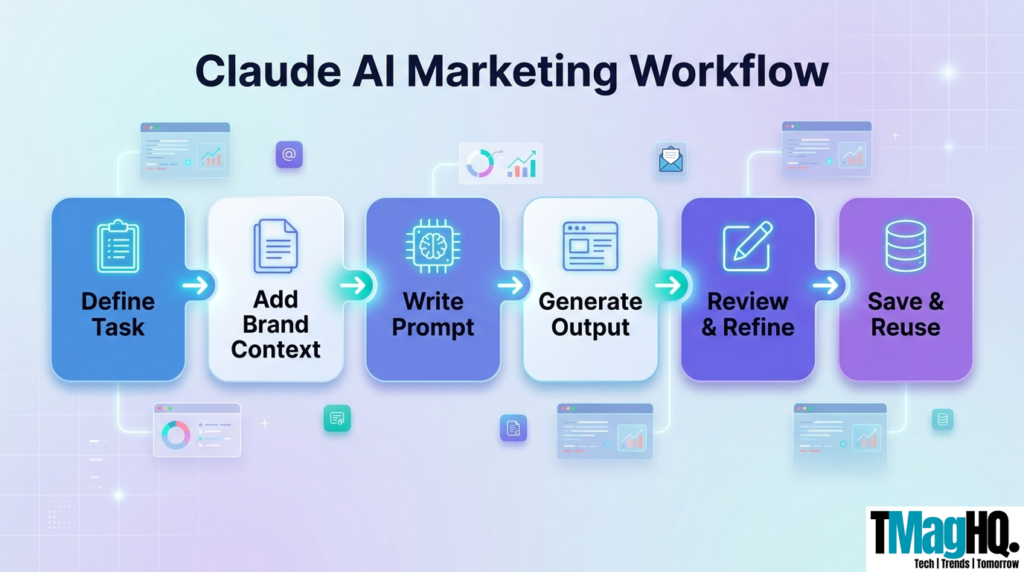
Step 1: Start with One Clear Use Case
Do not try to apply Claude AI for marketing across multiple tasks at once. Start with one area where you spend the most time, such as content briefs, email writing, or customer analysis. This helps you understand how Claude responds to your inputs and what kind of prompts work best. A focused start keeps the process simple and avoids confusion in the early stage.
Step 2: Create a Brand Context Document
Claude works better when it understands your brand clearly. Prepare a short document that explains your audience, tone, messaging, and any restrictions. This gives context before every task and improves output quality. When you use this consistently, Claude AI for marketing produces responses that require fewer edits and stay aligned with your overall communication style.
Step 3: Use Structured Prompts
The quality of your prompt directly affects the output. Instead of writing short instructions, define the role, provide context, explain the task, and mention the expected format. This structure reduces ambiguity and improves clarity. It is one of the most important parts of learning how to use Claude AI for marketing, especially when working on detailed tasks.
Step 4: Build a Prompt Library
As you work with Claude, you will notice that certain prompts give better results. Save these prompts instead of rewriting them each time. Over time, this creates a reusable system that improves both speed and consistency. Your collection of Claude AI marketing prompts becomes a practical asset that supports different parts of your workflow.
Step 5: Connect Claude to Your Workflow
Claude should support your existing tools, not replace them. Use your current systems for data collection and execution, and let Claude handle analysis and content generation. This creates a smoother process where each tool has a clear role. Using Claude AI for marketing in this way improves efficiency without disrupting your current setup.
Step 6: Review and Refine Output
Claude provides a strong starting point, but it should not be treated as final output. Always review the content, check for accuracy, and adjust tone if needed. This step ensures that your output stays aligned with your brand and maintains quality. Consistent review helps you get better results from Claude AI for marketing over time.
Step 7: Measure and Improve
To get real value, track how your AI-assisted work performs. Compare it with your previous results and identify areas where performance improves or drops. This helps you refine your prompts and workflow. When you measure consistently, you understand where Claude AI for marketing is contributing the most and how to improve further.
Putting It All Together
If you want to master how to use Claude AI for marketing, focus on building a simple and repeatable system. Start with one use case, improve your prompts, and refine your process over time. This approach makes your workflow more efficient and your output more consistent.
Real Example: Using Claude AI in a Marketing Workflow
To understand how to use Claude AI for marketing, it helps to see how it fits into a real workflow. The goal is not just to generate content but to connect multiple steps into one smooth process.
Consider a content marketer working on a new blog topic. Instead of starting from scratch, the process begins with research. The marketer collects competitor articles, keyword data, and a basic topic idea.
This information is then shared with Claude AI for marketing along with a clear prompt. Claude analyzes the input and identifies content gaps, common angles used by competitors, and opportunities to stand out. It then generates a structured content brief with headings, key points, and suggested direction.
Once the brief is ready, the marketer uses it to create the first draft. Claude can also assist in refining sections, improving clarity, and adjusting tone based on the brand context. This reduces the time spent rewriting and keeps the content consistent.
After publishing, the same workflow continues. Performance data such as engagement and user behavior can be shared with Claude. It helps identify what worked well and what needs improvement, making future content stronger.
This example shows that Claude AI for marketing is not limited to a single task. It supports the full cycle from planning to execution and improvement. When used this way, it becomes part of your process rather than just a tool you use occasionally.
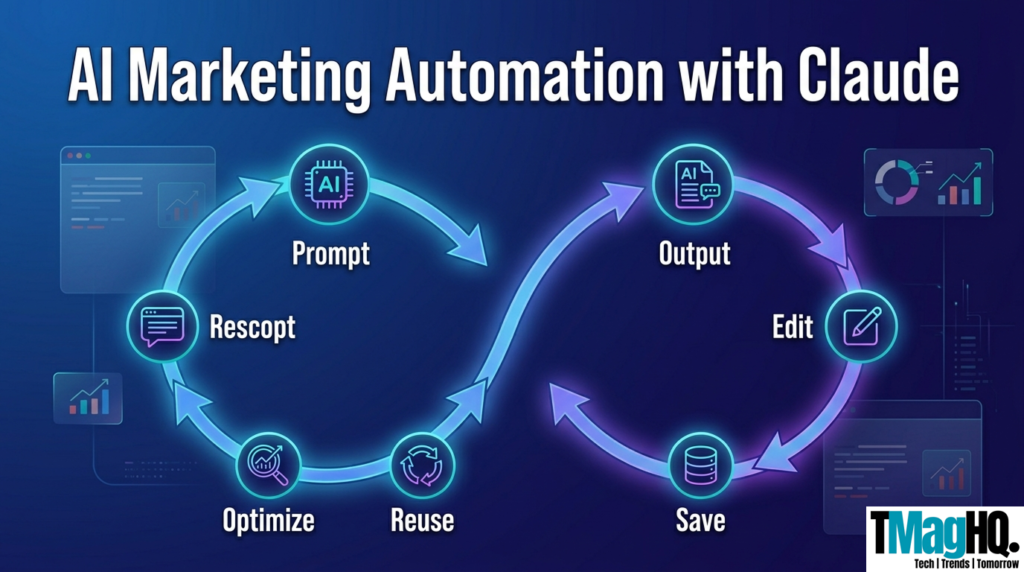
AI Marketing Automation with Claude
Once you understand how to use Claude AI for marketing, the next step is to make your workflow repeatable. This is where AI marketing automation becomes useful. It is not about replacing tools. It is about creating a system where tasks move faster with less manual effort.
With Claude AI for marketing, automation starts with consistency. When you use the same structured prompts and brand context across tasks, you reduce the need to repeat instructions. Each output follows a similar standard, which makes your workflow more predictable.
A simple example is content creation. Instead of planning every article manually, you use a saved prompt to generate a content brief. That brief follows a consistent format every time. You then move to drafting and editing using the same approach. This turns a one-time task into a repeatable process.
The same idea applies to email marketing. You can reuse a prompt to generate sequences based on different audience segments. The structure stays the same, but the messaging adjusts based on the input. This saves time while keeping communication aligned.
AI marketing automation with Claude also works well with data analysis and reflects the broader future of AI in marketing. You can input campaign results regularly and use a fixed prompt to extract insights. This helps you review performance without starting from scratch each time.
The key point is that automation with Claude is built through prompts and workflow design, not complex tools. As you refine your process, Claude AI for marketing becomes part of a system that supports planning, execution, and improvement.
How to Use Claude AI for Marketing: Quick-Start Checklist
If you want to start using Claude AI for marketing without confusion, follow this simple checklist. It keeps the process clear and easy to apply.
1. Set Up and Explore the Tool
Create your account and spend a few minutes understanding the interface. This helps you get comfortable before using it for actual tasks.
2. Create a Brand Context Document
Write a short document that includes your audience, tone, and key messaging. This improves how Claude AI for marketing responds to your prompts.
3. Choose One Use Case
Pick one task such as content creation, email writing, or analysis. If you are learning how to use Claude AI for marketing, starting with one focus area makes the process easier.
4. Write a Structured Prompt
Define your role, context, task, and output format clearly. This step has the biggest impact on the quality of results.
5. Review and Refine Output
Check the response, adjust tone if needed, and ensure it matches your brand. Claude provides a strong draft, but refinement is important.
6. Save Effective Prompts
Store prompts that give good results. Over time, your collection of Claude AI marketing prompts becomes a reusable system.
7. Track Performance
Measure how your content or campaigns perform. This helps you understand where Claude AI for marketing is improving your workflow.
This checklist helps you start quickly while keeping your process structured.
Conclusion
The way marketing gets done is changing. Tasks that once took hours can now be completed faster with the right approach. Learning how to use Claude AI for marketing gives you a practical advantage, not by replacing your work, but by improving how you do it.
You have seen how Claude AI for marketing fits into different parts of the workflow. It helps with planning, content creation, analysis, and ongoing improvement. When you combine clear prompts with a structured process, the output becomes more useful and consistent.
The key is to start simple. Choose one task, apply what you have learned, and refine your approach over time. As you build your own system, you will notice that your workflow becomes smoother and more efficient.
AI tools for marketing are becoming part of everyday work. Claude is one of the tools that can support this shift when used correctly.
Start with one prompt. Test it. Improve it. Then build from there.
FAQs
Is Claude AI good for marketing?
Yes, Claude AI for marketing works well for tasks that require structure and clarity. It is useful for content creation, customer analysis, and campaign planning. Because it handles context better than many tools, the output stays aligned with your goals and requires fewer edits.
How do I start learning how to use Claude AI for marketing?
Start with one task instead of trying everything at once. Choose something simple, like writing a content brief or analyzing customer feedback. Use a clear prompt with context and expected output. As you repeat this process, you will understand how to use Claude AI for marketing more effectively.
How to use Claude AI for marketing?
Use Claude AI for marketing to create structured content, analyze customer data, and automate workflows by giving clear prompts with context. It works best for long-form tasks, consistent brand voice, and data-driven decision-making.
Is Claude better than ChatGPT for marketing tasks?
It depends on the type of work. ChatGPT is faster for quick ideas and short content. Claude AI for marketing performs better when tasks involve long inputs, structured output, and consistent tone. Many marketers use both tools based on their needs.
Can Claude AI help with SEO?
Yes, Claude AI for marketing can support SEO tasks such as keyword clustering, content briefs, and search intent analysis. It helps organize information and plan content more effectively, especially when working with large keyword lists or competitor data.
Do I need technical skills to use Claude AI for marketing?
No technical skills are required. You only need to write clear prompts and provide enough context. Learning how to use Claude AI for marketing is more about improving how you give instructions rather than learning complex tools.
Can Claude replace marketers or copywriters?
No, it works as a support tool. Claude AI for marketing helps speed up tasks and improve structure, but human input is still needed for strategy, creativity, and final decisions. The best results come when you combine both.
Is Claude AI safe for business use?
Claude is designed with a focus on privacy. It does not use your conversations for training by default, which makes it suitable for handling business-related content. This makes Claude AI for marketing a reliable option for teams working with sensitive data.