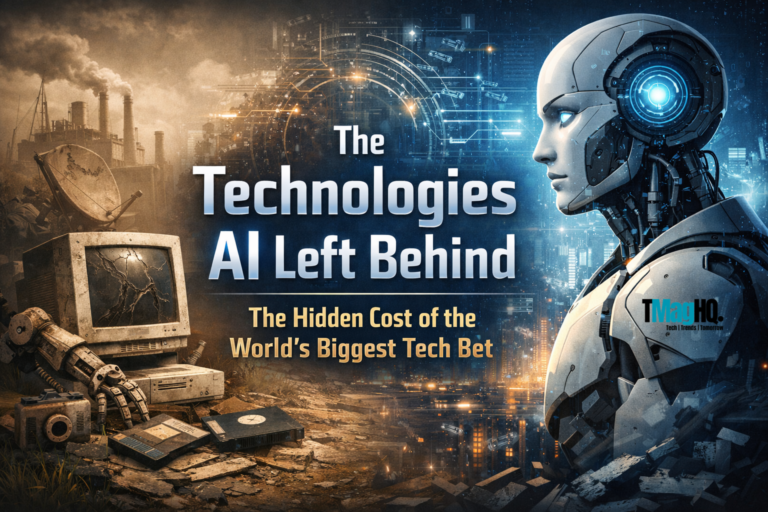
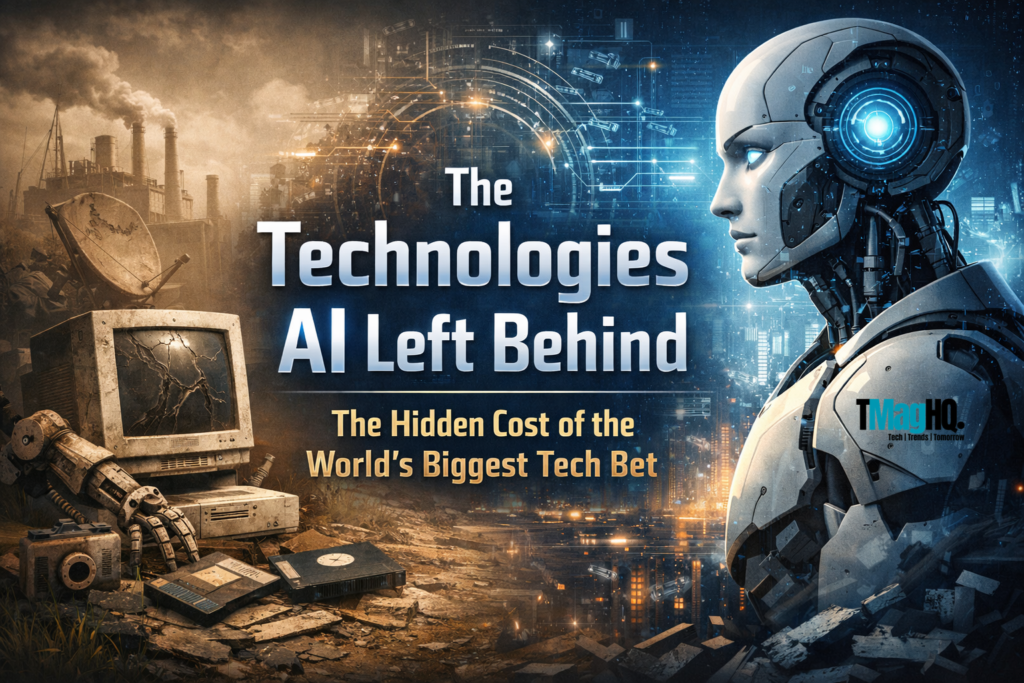
In early 2026, Meta made it official. After bleeding more than $83 billion through its metaverse division, the company announced it was scaling back Reality Labs — cutting budgets by roughly 30 percent and redirecting the money toward artificial intelligence. Mark Zuckerberg, who once declared the metaverse “the next chapter of the internet,” had a new priority.
“For Reality Labs, we are directing most of our investment towards glasses and wearables going forward.” – Mark Zuckerberg
The announcement barely made headlines. By then, the technology world had already moved on.
The Trillion-Dollar Race Nobody Could Ignore
The scale of the AI boom is unlike anything the technology industry has seen. Global AI spending is forecast to hit $1.5 trillion in 2025, according to Gartner. Microsoft, Alphabet, Amazon, and Meta alone committed a combined $320 billion to AI infrastructure in 2025.
Global VC investment in generative AI hit $49.2 billion in just the first half of 2025, already surpassing the entire 2024 total of $44.2 billion, according to EY. By 2026, the four biggest tech players are expected to nearly double their combined AI infrastructure spend to $700 billion.
“We are building something more transformative than the industrial revolution.” – Sam Altman, CEO, OpenAI
With that kind of money and conviction flowing in one direction, something had to give. And it did—across multiple industries, in ways most people never noticed.
Apple’s $10 Billion Dead End
For fifteen years, Apple secretly built a car. Project Titan, the company’s autonomous electric vehicle initiative, employed thousands of engineers and consumed an estimated $10 billion or more annually at its peak. It was supposed to be Apple’s next great product — a luxury self-driving vehicle that would redefine personal transportation.
In February 2024, Apple cancelled Project Titan entirely — walking away from fifteen years of autonomous vehicle research with no public explanation.
Tim Cook never gave a detailed public explanation. But Apple’s subsequent moves told the story clearly. The company redirected engineering talent and capital toward Apple Intelligence, its suite of on-device AI features. Resources that had chased Level 5 autonomy for over a decade were reassigned to large language models and generative AI systems.
Apple wasn’t alone. General Motors, Ford, and Volkswagen all retreated from autonomous vehicle development around the same time. Ford and Volkswagen jointly shut down Argo AI, their self-driving venture funded to the tune of billions, back in 2022. GM followed with significant cuts to its autonomous vehicle programs in 2024.
The industry that had promised fully autonomous roads by the mid-2020s quietly buried those timelines. Not because the technology failed — but because the money moved.
The Robot That Never Made It Home
Samsung’s Ballie robot was supposed to roll into living rooms around the world. Unveiled as a consumer product, the small AI-powered companion was designed to assist with household tasks, project content onto walls, and learn user routines over time. Samsung had genuine commercialization plans.
Then priorities shifted. Ballie was quietly demoted from a consumer product to an internal research project. Samsung redirected its focus toward AI-driven software platforms and wearables — areas where AI offered faster and clearer returns. The robot that once generated real excitement at CES became a lab exhibit.
The broader robotics sector felt the same pull. A field that seemed on the verge of a consumer breakthrough hit a wall — not because the technology failed, but because the money stopped coming.
Virtual Reality’s Stunning Collapse
The metaverse was supposed to be inevitable. In 2021 and 2022, Meta, Microsoft, and dozens of startups invested billions into virtual reality platforms, immersive experiences, and headset hardware. The vision was bold: a persistent virtual world where people would work, socialize, and spend.
By 2025 and into 2026, that vision had largely collapsed.
VR headset shipments fell 12 percent in 2024, marking the third consecutive year of decline. Funding for AR, VR, and metaverse startups dropped to some of the lowest annual totals in years.
Microsoft shut down its industrial metaverse division and laid off its entire HoloLens team. Horizon Worlds, Meta’s flagship virtual social platform, never approached the 500,000 monthly active users it originally targeted.
What makes this notable isn’t just the money lost — it’s the applications that got shelved along with it. VR has genuine, proven value in medical training, industrial design, military simulation, and education. Those use cases didn’t disappear. But sustained investment did.
Web Three’s $19 Billion Freefall
In 2022, Web3 was the future of the internet. Blockchain-based platforms, decentralized applications, and NFT ecosystems attracted $26.6 billion in venture funding that year alone, per Crunchbase. Hundreds of startups promised to reshape finance, gaming, art, and social media.
By 2023, Web3 VC funding had collapsed to under $7 billion — a 74 percent drop in a single year. In that same period, AI startups raised $25 billion in the first half of 2023 alone.
The steepest Web3 funding drops coincided almost exactly with the explosion of generative AI investment. Venture capital firms that maintained dedicated Web3 funds quietly rebranded as AI-focused investors. The narrative shifted almost overnight — and billions in committed capital followed.
The FTX collapse and broader crypto bear market played a role. But timing tells a sharper story than most analysts acknowledge.
NASA’s Moon Rover, Cancelled
Space exploration, long powered by the promise of impossible ambitions, wasn’t immune either.
In 2024, NASA cancelled the VIPER moon rover — a project designed to search for water ice near the lunar south pole — after consuming $450 million in development costs.
The Artemis program, America’s flagship return-to-the-moon initiative, also faced repeated delays and reduced funding momentum. Private space companies increasingly turned their attention toward AI applications in satellite operations and data analysis rather than expanding exploration frontiers.
Jensen Huang, CEO of Nvidia, captured the sentiment of the era when he said: “AI is the most powerful technology the world has ever seen.”
It was a statement that, explicitly or not, suggested everything else was secondary.
Quantum Computing’s Quiet Stall
Quantum computing once attracted serious research capital and genuine excitement. The technology promised to solve problems completely out of reach for classical computers — drug discovery, cryptography, materials science, climate modeling.
Then the AI boom began. Deloitte reported that quantum computing job growth slowed as enterprises redirected research budgets toward AI. Huang himself stated in early 2025 that quantum computing remains 15 to 30 years away from practical usefulness for most applications — a comment that shaped investor sentiment and quietly gave companies permission to deprioritize the field.
Funding continued, but urgency faded. Quantum computing became a long-term bet in an era demanding immediate returns. AI delivered those returns. Quantum computing didn’t—yet. And “yet” became a word fewer investors were willing to wait on.
The Irony Inside the Boom
There’s a harder truth buried inside this story.
Gartner predicts that over 40 percent of agentic AI projects will be cancelled by the end of 2027, citing escalating costs, unclear business value, and inadequate risk management.
Gartner’s own analysts note that agentic AI is already sliding into the “Trough of Disillusionment” — and that most enterprise AI projects are still proof-of-concept experiments driven more by hype than by strategic need.
Companies aren’t abandoning proven technologies for a guaranteed winner. They’re abandoning them for a technology that is itself burning through capital at unprecedented rates, with returns that remain uncertain for the majority of enterprise deployments.
The AI gold rush, in other words, is producing its own graveyard — just a quieter, less visible one.
What the Numbers Don’t Capture
The financial losses are staggering. But what the numbers don’t capture is the cost of delayed breakthroughs.
When Apple walked away from Project Titan, fifteen years of autonomous vehicle research went dormant. When robotics funding dried up, engineers who might have built the next generation of assistive technology moved to AI roles. When quantum computing lost urgency, research timelines stretched from years into decades. When VR funding collapsed, medical training tools, industrial design platforms, and educational applications lost momentum.
None of these technologies were speculative fantasies. They were serious, sustained, well-funded initiatives staffed by world-class researchers at the world’s most capable companies. Their deprioritization wasn’t driven by technical failure. It was driven by capital reallocation—the invisible hand of investment trends making decisions that no single executive consciously chose.
The Question No One Is Asking
AI investment will eventually plateau. Hype cycles always do. When that happens—when the returns on AI development face harder scrutiny and the capital flows slow—a question emerges that the industry isn’t yet ready to answer.
Will these abandoned technologies come back? Or are they permanently crippled, unable to recover the momentum, talent, and institutional knowledge that dispersed when the money moved?
Some will resurface, repositioned as AI-adjacent tools. Others will remain in research phases indefinitely. Some may be permanently lost—problems unsolved, breakthroughs never achieved, applications never built—because the resources weren’t sustained when they mattered most.
The world is betting everything on one technology. History suggests that’s rarely how progress actually works. The most important innovations often emerge from the periphery — from the fields nobody was watching, the research nobody was funding, the ideas nobody thought were worth the risk.
Right now, those fields are empty. The question is whether anyone will notice before it’s too late.