Key Takeaways
- Agentic AI refers to AI systems that can plan, decide, and complete multi-step tasks on their own
- Unlike chatbots, AI agents do not wait for your next prompt; they keep working until the job is done
- They combine large language models with tools, memory, and reasoning to act like a digital worker
- Real deployments are already live in customer service, software development, healthcare, and finance
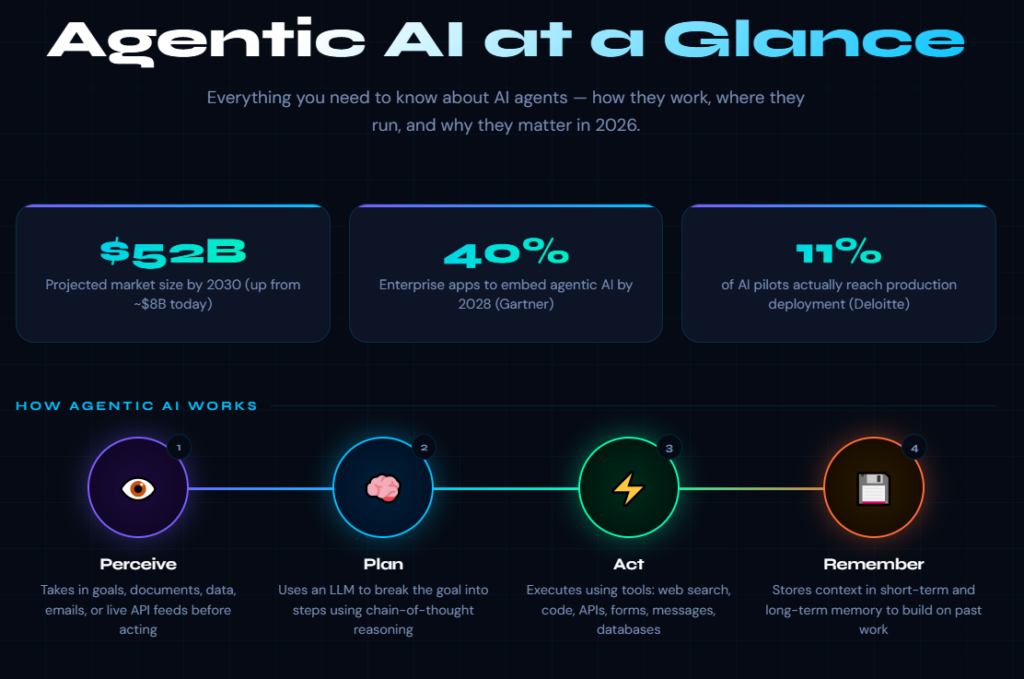
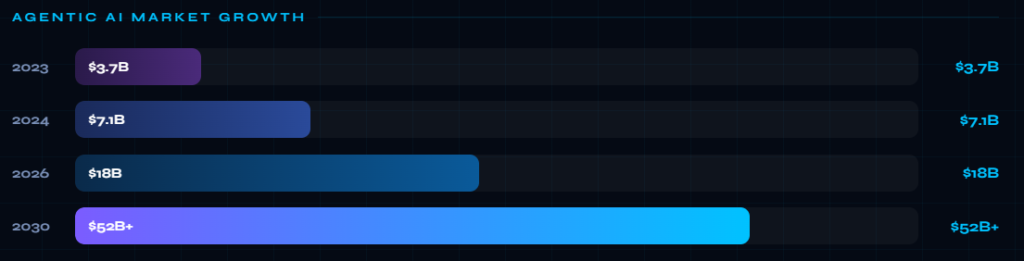
- The agentic AI market is on track to grow from around $8 billion today to over $52 billion by 2030
Picture this. You brief an AI on a task, say, researching ten competitors, pulling their pricing, and putting everything into a formatted report. Instead of giving you a half-answer and waiting for your next message, it goes ahead, searches the web, organizes the data, builds the report, and drops it in your folder. You come back to a finished job.
That is not a concept from a tech keynote. That is agentic AI working in production today.
For years, AI meant one thing: you type, it responds. Helpful, but still reactive. You were always the one moving it forward. Every next step needed another prompt from you.
Agentic AI breaks that pattern. You give it a goal, and it figures out the path. It plans the steps, picks the right tools, takes action, checks the results, and adjusts if something does not go as planned. The human is still in the picture, but not at every single step.
This shift is why companies like Google, Microsoft, Anthropic, and Salesforce are building heavily in this direction right now. Gartner estimates that by 2028, at least 40% of enterprise software applications will have agentic AI built into them. That number was nearly zero just two years ago.
This guide covers everything you need to know about agentic AI: what it actually is, how agentic AI works, where it is already being used, which tools matter, and what risks to keep in mind. No unnecessary complexity. Just a clear, honest breakdown from start to finish.
What Is Agentic AI?
Agentic AI is an AI system that can independently plan, make decisions, and carry out multi-step tasks to reach a defined goal without needing a human to direct every single move.
The word “agentic” comes from agency, which simply means the ability to act on your own. These systems do not just produce outputs when asked. They take initiative, use tools, track progress, and push toward an outcome.
Here is a simple way to think about it.
A standard AI assistant is like a smart colleague who only moves when you ask them to. You send a message, they reply. You give a task, they complete it. Then they wait for the next instruction.
An agentic AI is more like a capable person you have handed a project to. You explain the goal, they work out the steps, gather what they need, do the work, and only come back when something genuinely needs your decision.
For an AI system to be truly agentic, a few things need to work together.
- Goal-directed behavior means it works toward an outcome, not just a single reply. It keeps the end result in mind across every step it takes.
- Multi-step reasoning means it can break a big goal into smaller tasks and work through them in the right order.
- Tool use gives it real-world reach. An agentic AI can search the web, run code, call APIs, read documents, send emails, and update databases.
- Memory allows it to hold context across steps. Short-term memory tracks the current task. Long-term memory lets it recall information from past sessions and build on previous work.
- Adaptability means when a step fails or produces an unexpected result, it adjusts and tries another route instead of stopping.
These properties together are what make agentic AI a genuinely different category, not just a smarter chatbot.
Agentic AI vs Generative AI vs Traditional AI
These three terms come up together constantly, and they are genuinely different things. Mixing them up leads to wrong expectations, so it is worth being clear on each one.
Traditional AI was built for specific, narrow jobs. A spam filter that flags bad emails. A fraud detection model that spots unusual transactions. It was powerful within its lane but could not do anything outside of what it was trained for. No reasoning, no flexibility, no conversation.
Generative AI changed that. Systems like ChatGPT, Claude, and Gemini can write, summarize, translate, and explain. You give them a prompt and they generate a response. The interaction feels natural and flexible. But it is still fundamentally reactive. Every output requires a human input first, and the AI does not take action in the real world on its own.
Agentic AI takes the reasoning power of generative AI and adds the ability to act. It does not just produce a response and wait. It plans a sequence of steps, uses tools to carry them out, checks what happened, and continues until the goal is met.
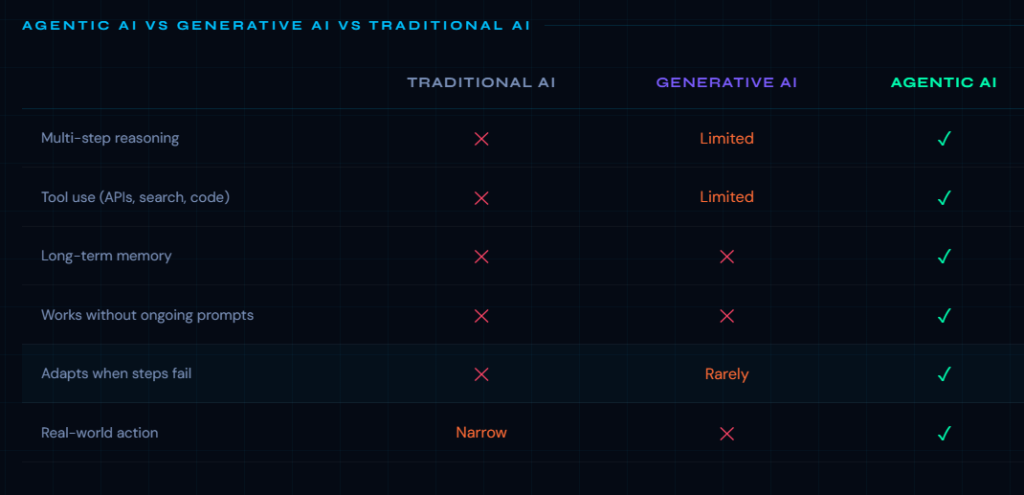
Here is a straight comparison across all three:
| Traditional AI | Generative AI | Agentic AI | |
| Primary function | Classify, predict, detect | Generate content on request | Plan and execute tasks autonomously |
| User interaction | Automated, rule-based | Prompt and response | Goal-based, minimal ongoing input |
| Multi-step reasoning | No | Limited | Yes |
| Tool use | No | Limited | Yes: search, APIs, code, forms |
| Memory | No | Short-term only | Short-term and long-term |
| Adaptability | Narrow | Moderate | High |
| Example | Spam filter, fraud detection | ChatGPT, Claude, Gemini | GitHub Copilot agent, Salesforce Agentforce |
The simplest way to put it: generative AI is the brain. Agentic AI is the worker.
Generative AI can write you a content strategy. Agentic AI can take that strategy, research the topics, draft the posts, schedule them, and report back on what it published. One produces an output. The other drives an outcome.
How Does Agentic AI Work?
Every agentic AI system, regardless of what it does or which platform it runs on, follows some version of the same four-step loop. Understanding this loop makes everything else about how agentic AI works much easier to follow.
A] Perceive
The agent starts by taking in information. This could be a goal you typed, a document it needs to process, live data from an API, an email inbox, or a webpage. It pulls in everything relevant before making a move.
B] Plan
This is where the large language model does its work. The agent uses the LLM as its reasoning engine to break the goal into a sequence of smaller tasks. It figures out what needs to happen first, which tools it will need, and what a completed outcome looks like. Many agents use a method called chain-of-thought reasoning here, where the model thinks through the problem step by step before acting.
C] Act
The agent executes its plan. This is where tool use comes in. Depending on what the task needs, it might search the web, write and run code, call a third-party API, send a message, update a spreadsheet, or hand off work to another agent in a multi-agent AI system. Every action produces a result that feeds into the next step.
D] Remember
The agent stores what it has done and learned. Short-term memory keeps the current task context intact. Long-term memory, usually stored in a vector database, lets the agent recall information from previous sessions and build on past work rather than starting from scratch every time.
After each action, the loop starts again. The agent perceives the result, re-plans if needed, acts again, and keeps going until the goal is complete or it reaches a point where a human needs to make a call.
This is the core structural difference between an AI agent and a chatbot. A chatbot resets after every response. An agent carries the thread all the way through.
Key Components of an Agentic AI System
Understanding the loop explains the behavior. Understanding the components explains how it is actually built and why certain deployments succeed where others do not.
1. The AI Agent
The agent is the core unit. It is the entity that receives a goal, reasons through it, and takes action. In a simple setup, one agent handles everything. In more advanced deployments, multiple specialized agents work together, each handling a specific part of a larger workflow.
2. The Orchestrator
In multi-agent AI systems, an orchestrator manages the overall process. It assigns tasks to the right agents, tracks progress, handles conflicts, and decides when to involve a human. Think of it as the project manager sitting above the individual workers.
3. Tools and APIs
Tools are what give an agentic AI its reach beyond text generation. Without tools, an agent can only reason and respond. With tools, it can search the web, execute code, read and write files, query databases, call external services, and interact with software interfaces. The range of tools an agent has access to directly determines what it can accomplish.
4. Memory
Memory works at two levels. Short-term memory holds the context of the current session, keeping the agent on track across multiple steps. Long-term memory stores information persistently, so the agent can reference past interactions, user preferences, or previous task outcomes in future sessions.
5. Human-in-the-Loop Checkpoints
No production agentic AI system runs entirely without human oversight, at least not responsibly. Human-in-the-loop checkpoints are built-in pause points where the agent stops and waits for a human to review, approve, or redirect before it continues. These checkpoints are especially important in high-stakes workflows like financial transactions, medical data handling, or any action that cannot be easily undone.
Each of these components needs to work well individually and together. A powerful agent with weak tools is limited. A well-tooled agent without proper memory loses context mid-task. And any agent without human oversight in critical moments is a liability.
Types of AI Agents
Not all AI agents are built the same way or designed for the same kind of work. The type of agent you use depends entirely on the complexity of the task and the level of autonomy that makes sense for that context.
A] Single Agents
A single agent handles an entire task on its own. It perceives the goal, plans the steps, uses tools, and executes from start to finish. Single agents work well for contained tasks like summarizing documents, generating reports, managing a specific workflow, or handling customer queries within a defined scope.
B] Multi-Agent Systems
A multi-agent AI system involves multiple agents working in coordination. One agent might handle research, another handles writing, and a third handles formatting and delivery. An orchestrator ties them together. This setup handles complex, parallel workflows that would be too large or too varied for a single agent to manage efficiently.
C] Specialist Agents vs Generalist Agents
Specialist agents are trained or prompted to do one thing extremely well, like a coding agent that only handles software tasks or a legal agent that only processes contracts. Generalist agents handle a broader range of tasks but may not match the depth of a specialist in any single area. Most enterprise deployments combine both.
D] Autonomous Agents vs Supervised Agents
Autonomous AI agents operate with minimal human input once they receive a goal. They are suited for low-risk, well-defined workflows where the steps are predictable. Supervised agents, on the other hand, check in at regular intervals or before taking any significant action. For most real-world business use cases today, supervised agents are the safer and more practical starting point.
Agentic AI in Action: Real-World Examples
The clearest way to understand what agentic AI actually does is to look at where it is already running.
► Software Development
GitHub Copilot’s agent mode does not just suggest lines of code anymore. It can take a feature request, plan the implementation, write the code across multiple files, run tests, identify failures, fix them, and open a pull request, all from a single instruction. Developers still review and approve, but the volume of manual steps has dropped dramatically.
► Customer Service
Klarna deployed an AI agent that handled over 2.3 million customer conversations in its first month. It managed refunds, order tracking, and account queries at a scale that would have required thousands of additional support staff. Response times dropped from eleven minutes to under two minutes on average.
► Healthcare
In healthcare settings, agentic AI handles appointment scheduling, insurance pre-authorization, and medical coding. These are high-volume, rules-driven tasks that previously ate up significant staff time. Agents process them faster, with fewer errors, and flag exceptions for human review rather than attempting to resolve them independently.
► Finance and Fintech
Financial institutions use AI agents for tasks like transaction monitoring, fraud pattern analysis, regulatory report generation, and client portfolio summarization. JPMorgan’s COiN platform, for example, processes legal documents in seconds that previously took lawyers thousands of hours annually.
► Marketing and Content
Marketing teams use agentic AI tools to run end-to-end campaign workflows. An agent can research a topic, pull competitor data, draft content, resize it for different platforms, and schedule it for publishing, cutting the production timeline from days to hours.
These are not pilot projects. These are active deployments producing measurable results across industries right now.
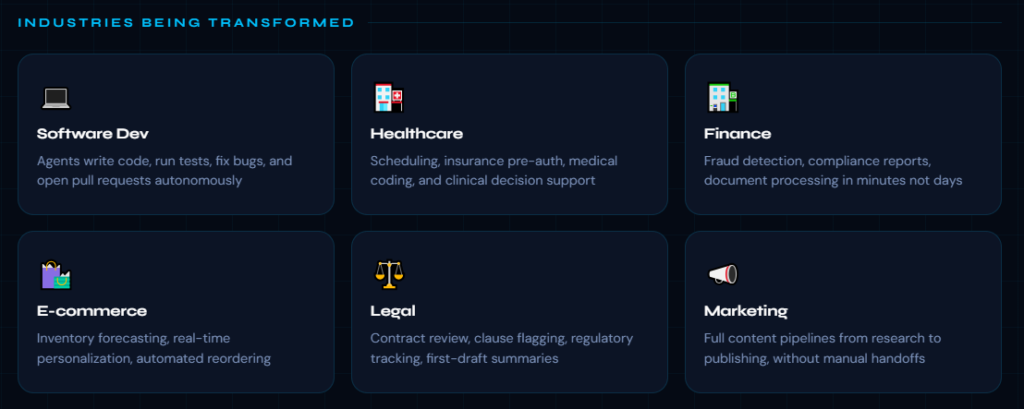
Industries Being Transformed by Agentic AI
Agentic AI is not sitting in a lab waiting to be ready. It is already inside real workflows across some of the world’s most demanding industries, handling tasks that used to take human teams hours or even days.
1. Software Development and DevOps
Development teams use AI agents to automate code reviews, manage CI/CD pipelines, detect bugs before deployment, and handle documentation. The result is faster release cycles and smaller backlogs without proportional increases in team size.
2. Healthcare
Beyond scheduling and coding, agentic AI in healthcare supports clinical decision workflows, patient follow-up communications, and research data extraction. Hospitals using agent-based systems report meaningful reductions in administrative overhead, freeing clinical staff to focus on patient care.
3. Finance
From loan processing to compliance monitoring, agentic AI in finance handles tasks that require pulling data from multiple sources, applying rules, and producing structured outputs. What used to take days in some workflows now takes minutes.
4. E-commerce and Retail
Retailers use AI agents to manage inventory forecasting, personalize product recommendations in real time, handle return processing, and respond to supplier queries. Agents that monitor stock levels and automatically trigger reorders are already standard in large retail operations.
5. Legal and Compliance
Law firms and compliance teams use agentic AI to review contracts, flag non-standard clauses, track regulatory changes, and generate first-draft summaries of complex documents. The agent handles the volume work; the lawyer handles judgment calls.
6. Marketing
Marketing teams benefit from agents that manage the full content production pipeline, from research and drafting to publishing and performance tracking, without needing a coordinator to push each step forward manually.
Agentic AI Tools and Platforms to Know in 2026
The tools in this space have moved fast. These are the platforms and frameworks that actually matter right now.
A] Claude (Anthropic)
Claude supports extended agentic AI workflows through its API and tools ecosystem. It handles long-horizon tasks, multi-step reasoning, and tool use reliably, and it is one of the more trusted models for enterprise deployments where accuracy and safety matter.
B] GPT-4o with Tools (OpenAI)
OpenAI’s GPT-4o supports function calling, code execution, web browsing, and file handling, making it a capable base for building AI agents across a wide range of applications.
C] GitHub Copilot Agent Mode
Built directly into the developer workflow, Copilot’s agent mode handles full feature implementation tasks inside the IDE. It is one of the most widely adopted agentic AI tools among software teams today.
D] Salesforce Agentforce
Agentforce lets businesses deploy AI agents across sales, service, and marketing workflows inside the Salesforce ecosystem. It is one of the most complete enterprise-ready agentic AI platforms currently available.
E] Cursor
Cursor is a code editor built around agentic AI capabilities. It can understand an entire codebase, make multi-file changes, and handle refactoring tasks that go well beyond what standard autocomplete tools offer.
F] AutoGen, LangGraph, and CrewAI
These are open-source frameworks for building custom multi-agent AI systems. AutoGen (from Microsoft), LangGraph (from LangChain), and CrewAI give developers the infrastructure to design, orchestrate, and deploy agents tailored to specific workflows without starting from scratch.
G] Model Context Protocol (MCP)
MCP deserves its own mention. Developed by Anthropic, the Model Context Protocol is an open standard that defines how AI agents connect to external tools, data sources, and services. Think of it as the common language that lets agents talk to the outside world consistently, regardless of which model or platform they run on. Many in the industry describe MCP as becoming the standard infrastructure layer for agentic AI, similar to what HTTP did for the web. If you are building or evaluating agentic AI systems, understanding MCP is no longer optional.
H] Google Agent-to-Agent Protocol (A2A)
Google’s A2A protocol is designed specifically for multi-agent AI systems where agents from different platforms or vendors need to communicate with each other. As enterprises deploy more complex agent networks, interoperability standards like A2A become critical infrastructure.
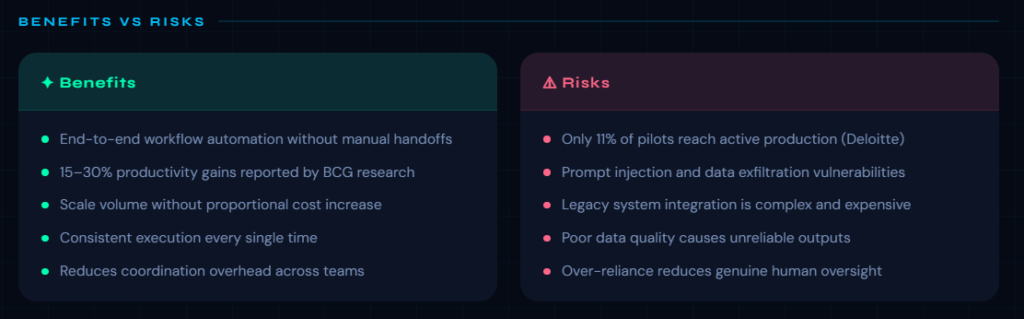
Benefits of Agentic AI
Getting work done faster is just one part of what agentic AI brings to the table. The bigger shift is in how much less coordination, follow-up, and manual effort teams need when an AI agent is handling the full process from start to finish.
1. End-to-End Workflow Automation
The most direct benefit of agentic AI is its ability to handle complete workflows rather than individual tasks. Instead of automating one step and handing off to a human for the next, an AI agent can own the entire process from start to finish.
2. Significant Time Savings
Tasks that take humans hours because of coordination, context-switching, and manual execution can run in minutes when an agent handles them. BCG research found productivity gains of 15 to 30 percent in teams that integrated agentic AI into their workflows.
3. Scalability Without Proportional Cost
A human team scales linearly. More work means more people. An agentic AI system can handle a much larger volume of work without a matching increase in cost. This is particularly valuable for businesses managing high-volume, repetitive processes.
4. Reduced Coordination Overhead
A significant portion of knowledge work is coordination: assigning tasks, following up, consolidating outputs, and moving information between tools. AI agents absorb most of that overhead, leaving teams to focus on the decisions that actually require human judgment.
5. Consistency
Unlike human workers who have variable days, agentic AI executes the same process the same way every time. For compliance-heavy workflows or customer-facing processes where consistency matters, this is a genuine advantage.
Challenges and Risks of Agentic AI
Agentic AI has real advantages, but it also comes with real challenges that are worth understanding before you commit to a deployment. The companies that run into trouble are usually the ones that moved fast without addressing the foundational issues first.
A] Low Production Deployment Rates
The gap between piloting agentic AI and actually deploying it at scale is larger than most expect. Deloitte research found that only about 11% of companies that pilot AI agents reach active production deployment. The reasons vary, but integration complexity, data quality issues, and governance gaps are the most common blockers.
B] Security Risks
Agentic AI systems that have access to tools, APIs, and real data introduce new security considerations. Prompt injection attacks, where malicious content in the environment tricks an agent into taking unintended actions, are a known vulnerability. Data exfiltration risks also increase when agents have broad access to internal systems. Security architecture needs to be part of the design from the start, not bolted on later.
C] Legacy System Integration
Most enterprises run on a mix of older systems that were never designed to work with AI. Getting AI agents to reliably connect with legacy infrastructure is often the hardest and most expensive part of any deployment.
D] Data Quality
An agentic AI system is only as good as the data it works with. Poor data quality is consistently cited as the number one factor behind failed deployments. Agents that pull from incomplete, inconsistent, or outdated data will produce unreliable outputs regardless of how capable the underlying model is.
E] Over-Reliance and Loss of Human Judgment
As AI agents become more capable, there is a real risk that teams stop questioning their outputs. For high-stakes decisions, maintaining genuine human oversight rather than just rubber-stamp approval is important. The goal is human-in-the-loop AI, not human-as-a-formality.
Agentic AI and the Future of Work
The conversation around agentic AI and jobs tends to swing between two extremes: complete replacement or zero impact. Neither is accurate.
What is actually happening is a shift in what human work looks like. Repetitive, high-volume, rules-driven tasks are moving to agents. The work that stays with humans involves judgment, creativity, relationship management, and decisions that carry ethical or strategic weight.
New roles are already emerging around this shift. AI agent trainers, workflow designers, prompt engineers, and agent oversight specialists are job titles that barely existed two years ago and are now actively being hired for.
Pricing models for AI are shifting too. The traditional subscription model is giving way to task-based billing, where you pay per outcome rather than per seat. This changes the economics of how businesses think about deploying agentic AI at scale.
The companies that will do well in this environment are not the ones that replace the most humans. They are the ones that figure out the right combination of agentic AI and human judgment for each type of work they do.
How to Get Started with Agentic AI
Starting with agentic AI does not require a large team or a massive budget. It requires a clear-headed approach to where it actually makes sense in your specific context.
Step 1: Identify the Right Workflows First
Look for processes that are high-volume, repetitive, and well-defined. The best candidates for agentic AI are workflows where the steps are predictable, the inputs are digital, and errors are recoverable. Start there before touching anything complex or high-stakes.
Step 2: Audit Your Data
Before deploying any agent, assess the quality and accessibility of the data it will work with. Clean, well-structured, accessible data is what separates successful deployments from frustrating ones. Fix the data foundation before building on top of it.
Step 3: Start with Supervised Agents
Resist the temptation to go fully autonomous on the first deployment. Start with agents that check in at key points and require human approval before taking significant actions. This builds trust, catches errors early, and gives your team time to understand how the agent behaves before extending its autonomy.
Step 4: Choose the Right Platform
Match the tool to the use case. For enterprise workflows, platforms like Salesforce Agentforce or Microsoft Copilot Studio offer structure and integration support. For custom builds, open-source frameworks like LangGraph or CrewAI give more flexibility. For individual productivity, tools like Claude or GPT-4o with tools are strong starting points.
Step 5: Build Governance Before You Scale
Define who owns each agent, what it is allowed to do, and what triggers a human review. Document the process. Set clear boundaries on data access. Put logging in place so you can audit what the agent did and why. Governance is significantly easier to build at the start than to retrofit after something goes wrong.
Agentic AI Trends to Watch in 2026
The agentic AI space is moving fast enough that what counts as cutting-edge today will likely be standard practice by the end of 2026. A few specific shifts stand out as particularly important for businesses and individuals trying to stay ahead of where this technology is heading.
[A] Multi-Agent Systems Going Mainstream
Single agents handling isolated tasks are giving way to networks of specialized AI agents that work in coordination. In 2026, multi-agent architectures are moving from research projects to production deployments across enterprise environments.
[B] MCP Becoming Standard Infrastructure
The Model Context Protocol is gaining rapid adoption as the standard way for AI agents to connect with external tools and data sources. As more platforms build MCP compatibility into their products, agent interoperability is improving significantly. It is shaping up to be the foundational protocol layer that agentic AI runs on.
[C] Agent Control Planes and Runtime Governance
As organizations deploy more agents, managing them becomes its own challenge. Agent control planes, which are centralized systems for monitoring, managing, and governing AI agent behavior across an organization, are becoming a standard part of enterprise agentic AI architecture.
[D] Task-Based AI Pricing
The shift from subscription pricing to outcome-based billing is accelerating. More agentic AI platforms are moving toward models where you pay per task completed rather than per user per month. This changes the ROI calculation for large-scale deployments significantly.
[E] Edge AI Meets Agentic Workloads
Running AI agents closer to the data source rather than through centralized cloud infrastructure reduces latency and improves performance for time-sensitive workflows. Edge deployments of agentic AI are growing, especially in manufacturing, healthcare, and logistics.
[F] 40% of Enterprise Apps Will Embed Agents
Gartner’s projection that 40% of enterprise software applications will have agentic AI embedded by 2028 is already visible in the product roadmaps of major software vendors. By the end of 2026, the majority of enterprise SaaS platforms will have some form of AI agent capability built in as a standard feature.
What Agentic AI Cannot Do Yet
Most content on this topic focuses entirely on what agentic AI can do. It is just as useful to be honest about current limitations.
► It struggles with truly open-ended goals.
Agents perform best when the goal is reasonably well-defined. Vague or highly ambiguous instructions lead to inconsistent behavior. The more clearly you define the outcome, the better the agent performs.
► It can confidently make wrong decisions.
LLMs can produce plausible-sounding reasoning that leads to incorrect actions. Without proper checkpoints, an agent can go several steps down the wrong path before anyone notices.
► It does not handle novel situations well.
Agents are good at patterns they have seen before. When they encounter a genuinely new situation outside their training or instructions, they often default to something familiar rather than flagging the uncertainty.
► It requires significant setup for complex workflows.
The promise of plug-and-play agentic AI is ahead of where the technology actually is for most enterprise use cases. Getting an agent to work reliably across a complex, multi-system workflow still requires meaningful engineering effort.
Being clear about these limitations is not pessimism. It is what allows teams to deploy agentic AI in places where it will actually succeed.
Conclusion
Agentic AI is not something that is coming. It is already here, already deployed, and already producing real results in industries ranging from software development to healthcare to finance.
The shift it represents is genuine. AI moving from a tool you prompt to a system that takes initiative and drives outcomes is a meaningful change in how work gets done. The businesses and individuals who understand that shift clearly, and who approach it with the right combination of ambition and caution, are the ones who will get the most out of it.
The key is starting with the right problems, building on clean data, maintaining real human oversight, and scaling gradually. Agentic AI works best when it is set up to succeed, not when it is thrown at the hardest problem in the organization on day one.
If you want to explore more about AI, tools, and how technology is changing the way we work, check out the rest of the content on TMagHQ.
FAQs
What is agentic AI in simple words?
Agentic AI is an AI system that can take a goal, figure out the steps needed to achieve it, and carry those steps out on its own using tools and reasoning, without needing a human to direct every move along the way.
Is ChatGPT an agentic AI?
Standard ChatGPT is a generative AI, not a fully agentic one. It responds to prompts but does not independently plan and execute multi-step tasks on its own. However, when connected to tools like web search, code execution, or external APIs, it can take on limited agentic AI behaviors.
What is the difference between AI agents and chatbots?
A chatbot responds to a message and waits for the next one. An AI agent receives a goal and works through multiple steps to complete it, using tools and memory along the way. A chatbot is reactive; an AI agent is proactive.
Which companies are using agentic AI?
Companies actively using agentic AI in production include Klarna, JPMorgan, Microsoft, Salesforce, GitHub, Google, and a growing number of mid-size enterprises across finance, healthcare, legal, and retail sectors.
Is agentic AI safe to use?
Agentic AI can be used safely when deployed with proper guardrails: clear scope limits, human-in-the-loop checkpoints, strong data governance, and regular auditing of agent behavior. The risk increases when agents are given broad access and minimal oversight without a proper governance framework in place.
What is MCP in agentic AI?
MCP, or Model Context Protocol, is an open standard developed by Anthropic that defines how AI agents connect to external tools, data sources, and services. It allows agents built on different models or platforms to interact with the outside world in a consistent, interoperable way. It is quickly becoming a foundational part of how agentic AI infrastructure is built.