

🔑 Key Takeaways
- Understand your audience and search intent first, before creating any content.
- Do proper keyword research to target relevant and high-impact search terms.
- Analyze competitors strategically to identify gaps and improve your content quality.
- Follow a clear content strategy instead of publishing randomly without direction.
- Optimize on-page SEO basics including titles, headings, and structure.
- Fix technical SEO issues to ensure your site is fast and mobile-friendly.
- Keep your website structure simple so users and search engines can navigate easily.
- Set realistic expectations as SEO takes time to deliver results.
- Track performance consistently using analytics and SEO tools.
- Focus on quality link building to build long-term authority and rankings.
Many people start SEO with high hopes but see little to no results. The main reason is simple. They skip the basics.
SEO is not just about adding keywords or writing blog posts. It starts with planning. If your website is not ready, even the best content will not rank.
Before you begin, you need to understand a few key things. Who is your audience? What are they searching for? Is your website ready for search engines?
When you take time to prepare, your chances of success improve. You attract the right traffic. You build better content. You avoid common mistakes that waste time.
In this guide, you will learn the most important factors to consider before starting SEO. These steps will help you build a strong base and move in the right direction.
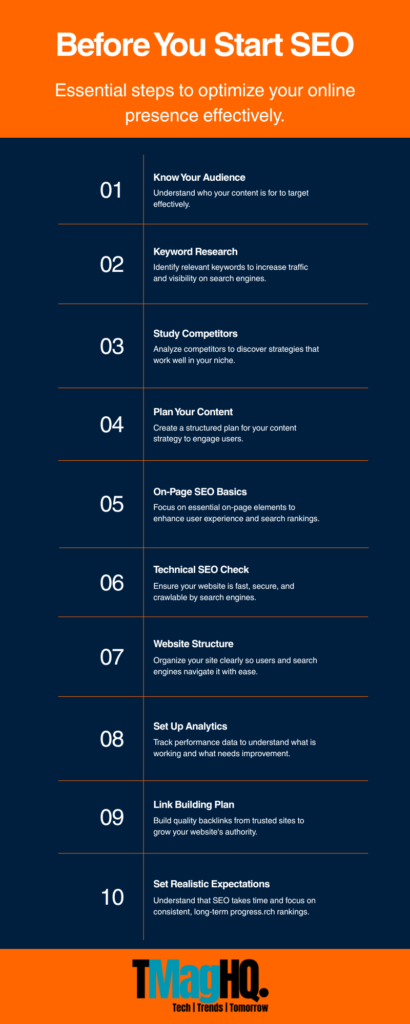
1. Understand Your Target Audience and Search Intent
Before you start SEO, you need to know who you are writing for. If you skip this step, your content may attract the wrong people or no one at all.
Start by defining your audience. Think about their age, work, and needs. What problems are they trying to solve? What kind of content do they prefer?
For example, a beginner may search for simple guides. An expert may look for detailed strategies. Your content should match their level.
Next comes search intent. This means the reason behind a search.
Most searches fall into three types:
- Informational: people want to learn something
- Navigational: people want to find a specific website
- Transactional: people want to take action or buy
If your content does not match the intent, it will not rank well.
For example, if someone searches “how to start SEO,” they expect a guide. If your page tries to sell a service instead, they will leave quickly.
When you understand both your audience and their intent, your SEO becomes more focused. You create content that answers real questions and brings the right visitors.
2. Conduct Proper Keyword Research
Keyword research is the basis of any SEO strategy. It helps you understand what people are searching for and how you can reach them.
Start by finding keywords related to your topic. Focus on terms that your audience actually uses. Avoid guessing.
Use tools like Google Keyword Planner or Ubersuggest to get ideas. Look at search volume and competition before you choose a keyword.
Focus more on long-tail keywords. These are longer and more specific phrases. They may have lower search volume, but they bring better traffic.
For example:
- “SEO” is too broad
- “SEO tips for small business website” is more tar. geted
Also, check the intent behind each keyword. A keyword may look good, but if it does not match your content, it will not help.
Try to balance between:
- Low competition keywords
- Relevant search terms
- Clear user intent
Good keyword research makes your content easier to find. It also helps you attract people who are more likely to engage with your website.
3. Analyze Your Competitors
Before you start SEO, take time to study your competitors. This helps you understand what already works and where you can do better.
Search your main keywords on Google and look at the top results. These are your real competitors.
Check what they are doing:
- What topics are they covering
- How detailed their content is
- Which keywords are they targeting
Pay close attention to gaps. Maybe they missed a key point or did not explain something clearly. That is your chance to create better content.
Also, look at their backlinks. This shows where they are getting authority from. It can give you ideas for your own link-building strategy.
Do not copy their content. Instead, aim to improve it. Add more clarity, better structure, and useful insights.
When you understand your competitors, you make smarter decisions. You focus on what works and avoid wasting time on things that do not.
4. Build a Strong Content Strategy
One of the key factors to consider before starting SEO is having a clear content plan. Without it, your efforts can feel random and disconnected.
Start by deciding what topics you want to cover. These topics should match your audience’s needs and your business goals.
Group your content into related themes. This helps search engines understand your website better and improves your chances of ranking.
A simple way to do this is:
- Create one main page on a broad topic
- Add supporting articles that cover smaller parts of that topic
This approach builds depth and authority.
Also, focus on creating helpful content. Each piece should answer a question or solve a problem. Avoid writing just to fill space.
Keep your structure clean:
- Use clear headings
- Break content into short sections
- Make it easy to read
5. Consistency also matters. Posting regularly helps search engines trust your website.
When you plan your content well, your SEO becomes more effective. It ensures that every page on your site has a purpose and supports your overall growth.
Focus on On-Page SEO Basics
Another important factor to consider before starting SEO is how well your pages are optimized. Even strong content can fail if basic SEO elements are missing.
Start with your title. It should include your main keyword and clearly tell what the page is about.
Next, write a clear meta description. This is what users see on search results, so it should encourage them to click.
Use proper headings to organize your content. Your H1 should cover the main topic. H2 and H3 should break down the content into simple sections.
Place your keywords where they fit naturally:
- In the title
- In the first few lines
- In headings
- Within the content
Avoid overusing them. Keep it natural and easy to read.
Also, focus on internal linking. Link to other relevant pages on your site. This helps users explore more and improves your site structure.
Do not forget images. Use clear file names and add alt text with relevant keywords. This helps with both SEO and accessibility.
When your on-page SEO is strong, search engines can understand your content better. This increases your chances of ranking higher.
6. Ensure Technical SEO Readiness
One of the most critical factors to consider before starting SEO is your website’s technical health. If your site has issues, your content may not even get indexed.
Start with website speed. A slow site can drive users away and hurt your rankings. Use tools like Google PageSpeed Insights to check performance.
Next, make sure your website is mobile-friendly. Most users now browse on their phones. If your site does not work well on mobile, you lose traffic.
Your website should also be secure. Use HTTPS to protect user data. Search engines prefer secure websites.
Check if your pages can be crawled and indexed. This means search engines should be able to access and understand your content.
Set up:
- XML sitemap to guide search engines
- Robots.txt to control what gets crawled
Keep your URLs clean and simple. Avoid long and confusing links.
Fix broken links and remove errors. These small issues can affect your site’s performance over time.
When your technical setup is strong, it supports all your SEO efforts. It ensures that your content can be found, read, and ranked properly.
7. Optimize Website Structure
Another key factor to consider before starting SEO is how your website is organized. A clear structure helps both users and search engines find content easily.
Start by grouping related pages together. Each category should focus on a specific topic. This makes your website easier to understand.
Your navigation should be simple. Users should reach any important page in a few clicks. If visitors get confused, they will leave.
Use clean and readable URLs. For example:
- Good: /seo-basics
- Avoid: /page?id=123
Internal linking also plays a big role. Link related pages to each other. This helps users explore more and keeps them on your site longer.
Try to keep a flat structure. This means important pages are not buried too deep. Search engines can crawl such sites more easily.
When your website structure is clear, it improves user experience and supports better rankings. It also makes your SEO efforts more effective over time.
8. Set Up Analytics and Tracking
Another important factor to consider before starting SEO is tracking your performance. Without data, you will not know what is working and what needs improvement.
Start by setting up Google Analytics. It helps you understand how users interact with your website.
You can track:
- Number of visitors
- Traffic sources
- Time spent on pages
Next, set up Google Search Console. This tool shows how your website performs in search results.
It helps you:
- Track keyword rankings
- Check indexing status
- Find errors on your site
Pay attention to user behavior. If people leave your page quickly, your content may not match their needs.
Tracking also helps you make better decisions. You can focus on what brings results and improve what does not.
When you measure your performance from the start, your SEO becomes more focused and effective.
9. Understand Link Building Before You Start
One more important factor to consider before starting SEO is how you plan to build links. Backlinks help search engines trust your website.
A backlink is a link from another website to yours. When trusted sites link to you, it signals that your content is valuable.
Focus on quality over quantity. A few strong links are better than many weak ones.
You can build links by:
- Writing guest posts
- Listing your site in trusted directories
- Creating useful content that others want to share
Avoid shortcuts. Buying links or using spammy methods can harm your website.
Also, make sure your links are relevant. A link from a related website carries more value than one from an unrelated source.
Good link building takes time, but it supports long-term growth. It helps improve your rankings and brings steady traffic.
10. Set Realistic SEO Expectations and Timeline
A crucial factor to consider before starting SEO is understanding how long it takes to see results. Many people expect quick wins, but SEO does not work that way.
SEO takes time. In most cases, it can take a few months before you notice steady growth. This depends on your competition, content quality, and website strength.
In the beginning, you may see slow progress. That is normal. Search engines need time to crawl, index, and evaluate your website.
Focus on consistent effort:
- Publish useful content
- Improve your website regularly
- Track your performance
Do not expect instant rankings or traffic spikes. SEO builds over time and grows step by step.
Also, think of SEO as an investment. The results may take time, but they last longer compared to paid ads.
When your expectations are clear, you stay patient and make better decisions. This helps you build a strong and stable online presence.
11. Common Mistakes to Avoid Before Starting SEO
Before you begin, it is important to know what not to do. Avoiding mistakes is a key factor to consider before starting SEO.
- One common mistake is skipping the basics. Many people jump into content creation without proper research or planning.
- Another issue is targeting the wrong keywords. High-volume keywords may look attractive, but they are often too competitive for new websites.
- Ignoring technical SEO is also a problem. If your website is slow or not mobile-friendly, your rankings will suffer no matter how good your content is.
- Some websites publish content without a clear strategy. This leads to scattered topics that do not build authority.
- Overusing keywords is another mistake. It makes content hard to read and can harm your rankings.
- Many beginners also expect quick results. When they do not see progress, they stop too soon.
Avoiding these mistakes helps you stay on the right path. It saves time and ensures that your SEO efforts bring better results.
Final SEO Checklist Before You Begin
Before you start, go through this quick list. It covers the most important factors to consider before starting SEO and helps you stay on track.
- Define your target audience clearly
- Understand search intent for your main topics
- Complete proper keyword research
- Study your competitors and find content gaps
- Plan your content strategy
- Optimize basic on-page SEO elements
- Fix technical issues on your website
- Improve your website structure and navigation
- Set up analytics and tracking tools
- Plan a basic link-building approach
- Set realistic expectations for results
This checklist gives you a strong starting point. It ensures that you do not miss any key steps before beginning SEO.
Conclusion
SEO works best when you build a strong base first. Rushing into it without planning often leads to poor results.
When you focus on the right factors to consider before starting SEO, your efforts become more effective. You attract the right audience, create better content, and improve your chances of ranking.
Take your time to prepare. Fix the basics. Follow a clear plan.
Once your foundation is ready, SEO becomes much easier to manage and scale.
Start with the right approach, and your website will grow in a steady and sustainable way.
What are the key factors to consider before starting SEO?
The most important factors include understanding your audience, knowing search intent, doing proper keyword research, checking technical SEO, and planning your content. These steps help you build a strong base before you begin.
How do I prepare my website for SEO?
Start by fixing technical issues like speed and mobile usability. Then plan your content, optimize basic on-page SEO, and set up tracking tools. This ensures your website is ready to perform well in search results.
Why is keyword research important before starting SEO?
Keyword research helps you understand what people are searching for. It allows you to create content that matches user needs and brings relevant traffic to your website.
How long does it take to see results from SEO?
SEO usually takes a few months to show steady results. The timeline depends on your competition, content quality, and how well you follow the right steps from the start.
Can I start SEO without technical knowledge?
Yes, you can start with basic steps like content and on-page SEO. However, understanding technical SEO will improve your results and help your website perform better.
What is the biggest mistake to avoid before starting SEO?
One of the biggest mistakes is starting without a plan. Skipping research, ignoring search intent, or not fixing technical issues can slow down your progress.