Artificial Intelligence is transforming the job market, creating new career paths for professionals across industries. One common question many learners ask today is whether they should focus on prompt engineering or pursue full AI courses.
While prompt engineering focuses on effectively using AI tools like ChatGPT, Gemini, and Midjourney, AI courses teach the technical foundations required to build artificial intelligence systems. Both paths involve AI but require different levels of technical knowledge and career goals.
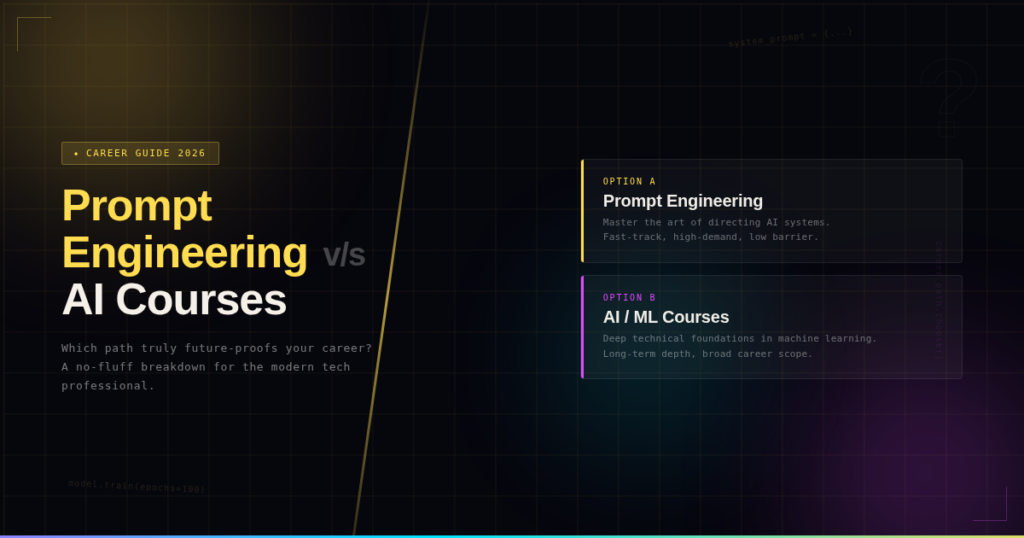
In this guide, we will compare prompt engineering vs AI courses, including learning difficulty, career opportunities, industry demand, and future scope in 2026. This will help you decide which AI career path aligns best with your skills and professional goals.
Overview
A common tech trend that is present and being discussed everywhere is “Artificial Intelligence”. From the manufacturing sector to the service sector, every business and professional is concerned about how AI is going to reshape the future. Such chaos is not something new in the industry, but every decade, there is an innovation or advancement that replaces the traditional way of working.
From the introduction of machines in the Industrial Revolution, to computers, then the internet, and now AI or Artificial Intelligence. Hence, following such a shift, it also becomes important for job-seekers to explore the opportunities and update their skills to stay relevant as per the latest industry trends.
ChatGPT by OpenAI was the first commonly known AI tool that came into the spotlight during and post-pandemic. Further, it was followed by Google’s Bard (now Gemini), Midjourney, and many others. Such a rapid rise of these AI tools in the past 4–5 years has introduced a new learning path for all. With industries planning to adopt AI and automation in their everyday operations, choosing the right learning or career path has become important for all.
The best way to decide on such a path is to ask yourself in what direction you want to proceed. With AI, there can be two scenarios: 1. To learn how to build or develop AI applications, 2. Learn how to operate them to their best. Also, it can be done as: “Should I learn how to prompt better, or proceed with a full-fledged AI course?” The choice is yours, and this blog will help you make such a choice by breaking down the concepts and helping you understand where you fit best.
Let’s begin.
What is Prompt Engineering?
Before understanding what Prompt Engineering is, we need to understand more about “Prompts”.
What is a Prompt?
AI tools such as ChatGPT, Gemini, and other generative AI platforms rely on instructions provided by users. These instructions are known as prompts, and they guide the AI system in generating responses, content, images, or code.
Prompts are nothing, just the set of instructions that you give to any AI tool or Large Language Model, and based on which they generate outputs.
Prompt Engineering:
While giving prompts, you need to be aware of the consequences, as these AI tools are open-ended and based on the interactions, they generate results. Also, they only read your prompts, and there are no emotions involved. Hence, for every set of input you give to AI tools, there will be an entirely different output. So, now you know that not every type of input will get you to the desired outcomes.
Hence, to master the art of generating effective prompts, you need to go with Prompt Engineering. Pursuing Prompt Engineering can help you explore the art and science of generating prompts that can be passed on to AI models to generate relevant and creative outputs. In other words, Prompt engineering is a learning path that helps you learn how to give instructions to Generative AI so that it can provide expected outputs. As AI is expected to replace humans in any process, but to start them, it is important to provide them with detailed guidance.
Let’s suppose you want any AI tool, let’s take ChatGPT, to write an email reply to your boss/university/client, or anyone else. Hence, for this, you need to provide a brief to ChatGPT about what you are expecting and what the end result should be. Such a brief or instruction needs to be in detail and include every detail that you want the AI tool to include in that reply. Hence, the provided brief is the prompt, based on which you will get the output. Further, how you should structure your prompt is part of prompt engineering.
What Are AI Courses and What Do They Teach?
AI courses are structured learning programs designed to teach the technical foundations of artificial intelligence. Unlike prompt engineering, which focuses on interacting with AI tools, AI courses focus on building and developing intelligent systems using programming, machine learning, and data science.
Depending on your interest area, you can opt for online certifications in AI, register for boot camps, or even take a graduation or post-grad degree in artificial intelligence from reputed universities. A basic AI course covers some important topics, including:
- Deep Learning
- Cloud Computing
- Data Science
- AI programming
- Predictive Analysis
- Machine Learning
- Real-World Applications
- Data Management
- & Other course-specific topics
Students who complete AI courses often pursue careers such as AI engineer, machine learning engineer, or data scientist, making it a long-term AI career path for technical professionals.
Prompt Engineering vs AI Courses: Key Differences
Choosing between prompt engineering and AI courses depends on your career goals, technical background, and learning preferences. While both fields involve artificial intelligence, they focus on different skill sets and career outcomes.
The following comparison highlights the key differences between prompt engineering and AI courses.
| Criteria | Prompt Engineering | AI Courses |
| Learning Curve | Easy to Start | Ranges from Foundational to Expert |
| Tools Used | Any AI tool (ChatGPT, Gemini, Midjourney) | Coding Languages and Tools (TensorFlow, Python, and more) |
| Scope of Learning | Limited (as just focus on learning about prompts) | Broad (teaches students how to generate AI models and programs) |
| Time Commitment | Short-Term | Long-Term |
| Coding Required | No | Yes |
| Output of Program | Ability to generate content and output as per set expectations | Build and develop AI models and systems |
| Potential Career Roles | Prompt Engineer, Automation Strategist, AI Content Creator | AI/ML Engineer, Data Scientist |
When To Choose What?
So, before you opt for any of the learning paths, either Prompt Engineering or AI courses, you must know the basic aspects or factors of what should be chosen and when.
When To Choose Prompt Engineering?
Prompt Engineering aims to improve your interactions with the language model or the AI tool. Hence, such learning is important when you need to showcase your subject matter expertise, creativity, or critical thinking. Following such, it won’t be wrong to mention that Prompt Engineering is effective if:
- You belong to a non-tech background with no coding knowledge and want to leverage the best of the AI tools.
- Want to focus on better productivity through AI, enhanced content, and creative automation.
- You work in or aim to be in the functional areas of business, like Marketing, Sales, Design, HR, or Content Creation.
- You are interested in exploring all that AI can do and using it for creative purposes.
When To Choose AI Courses?
AI courses can help you develop a deeper understanding of the AI models and programs. Hence, you should take AI courses when:
- You want to build your career in the field of Artificial Intelligence or Machine Learning
- You want to transition into the field of building AI tools and programs
- You have a background in data and coding or are interested to learn it.
- You are looking to future-proof your career.
- If you want to explore the potential impacts of AI in terms of both operational and ethical usage.
Industry Trends 2026 and Beyond
When deciding between prompt engineering vs AI courses, it is important to understand the current industry trends shaping the future of artificial intelligence careers. As AI adoption continues to grow across industries, professionals are increasingly required to develop AI skills that align with future job demands.
In 2026, organizations across sectors such as technology, marketing, healthcare, and finance are integrating AI into everyday operations. Because of this rapid adoption, both prompt engineering skills and advanced AI development expertise are becoming valuable depending on the career path an individual chooses.
The following industry trends can help you understand which learning path — prompt engineering vs. AI courses — might be more suitable for your professional goals.
AI Accessibility for Non-Technical Professionals
One of the biggest trends in 2026 is the growing accessibility of AI tools. Platforms such as ChatGPT, Gemini, Copilot, Grok, and DeepSeek have made artificial intelligence easier to use for non-technical professionals.
Because of this accessibility, many professionals in fields such as marketing, content creation, HR, and business operations are learning prompt engineering to improve productivity and automate workflows. This has increased interest in prompt engineering as a practical skill for professionals who want to work with AI tools without learning advanced programming.
At the same time, the growing demand for AI-powered products continues to create opportunities for developers and engineers who pursue advanced AI courses and technical AI career paths.
Increasing Focus on Skill-Based Hiring
Another major trend shaping the AI career landscape in 2026 is the shift toward skill-based hiring. Many companies now prioritize practical skills and real-world experience over traditional academic credentials.
As a result, professionals are increasingly enrolling in AI courses, engineering certifications, and practical AI training programs to strengthen their career prospects. Short-term learning programs and online certifications have made it easier for both technical and non-technical professionals to develop AI skills relevant to modern job roles.
Whether someone wants to build AI systems or simply use AI tools more effectively, learning AI-related skills is becoming an important requirement in the job market.
Growth of AI-Driven Job Roles
The debate about whether AI will replace jobs continues, but the reality in 2026 is that AI is transforming jobs rather than eliminating them. Many organizations now expect employees to understand how to work alongside AI systems.
From marketing teams using generative AI to software engineers building machine learning models, AI integration is becoming a standard part of modern workplaces. Because of this shift, professionals who understand AI tools, prompt engineering techniques, or AI development frameworks have a competitive advantage in the job market.
Developing AI-related skills can therefore help professionals explore new opportunities across industries and build a sustainable AI career path.
The Continued Importance of Technical AI Expertise
While prompt engineering is becoming a valuable skill, technical AI expertise remains highly specialized and in demand. Roles such as AI engineers, machine learning engineers, and data scientists require strong knowledge of programming, algorithms, and data science.
These roles often require professionals to complete structured AI courses or formal education programs that cover advanced topics like machine learning, deep learning, and neural networks.
Although these careers involve a higher learning curve, they also offer long-term growth potential and strong demand in the global technology industry.
Choosing the Right AI Career Path
Ultimately, choosing between prompt engineering and AI courses depends on your background, career goals, and the type of work you want to pursue.
Professionals working in content creation, marketing, freelancing, or entrepreneurship can benefit significantly from learning prompt engineering to improve productivity and automate tasks using AI tools.
On the other hand, individuals who want to build AI systems, develop intelligent applications, or work in fields like machine learning, data science, and AI research should consider pursuing structured AI courses that provide deeper technical expertise.
Understanding these industry trends in 2026 and beyond can help professionals choose the right path and develop the AI skills needed for future jobs.
Should You Do Both?
Now the question arises, “Should you or can you do both?”
Learning never stops, and it also doesn’t have any limit to follow. Hence, it depends on your interest levels and your ability to learn and take a deeper dive into the concepts. Hence, yes, you can do both, but before proceeding, you should plan your career and the direction you want to take it. Simply taking on AI courses without any set professional or career path will result in just a pile of certificates with no contribution to your career.
You can start with prompt engineering to understand how AI works and how to use it to its maximum potential. Further, once you have gained the basic knowledge and understanding of AI, you can proceed with formal and dedicated AI courses that can help explore the technical side of AI and can prepare you for a competitive industry environment.
Who Can Benefit from such a learning graph?
Whether to go for both or stay aligned with either of the learning backgrounds depends on your interest. However, a basic evaluation can be done to define who should consider doing both courses. Such can be:
Entrepreneurs
Individuals who are building new-age businesses or planning to serve modern customers with an excellent product/service experience. The entrepreneurs can leverage AI to create MVPs and can further proceed with custom AI development when required.
Digital Marketers
Going through the complexities of AI can be beneficial even for digital marketers. It can allow them to create digitally optimized campaigns, utilize data-driven models to get real-time recommendations, and much more.
Product Managers
If you are a product manager, then learning such skills can allow you to make necessary adjustments without the help of developers and complete projects on time with maximum efficiency.
Developers
Learning AI can be the best way to future-proof careers for developers. Hence, they can focus on understanding both. As AI knowledge can help them build creative AI solutions, and smart prompting can further assist them with testing and improving the UI experience.
Conclusion
Choosing between prompt engineering vs AI courses depends largely on your career goals and technical background. Prompt engineering focuses on effectively using AI tools to generate results, automate workflows, and improve productivity, making it a valuable skill for professionals in marketing, content creation, business, and other non-technical roles.
On the other hand, AI courses provide deeper technical knowledge in areas such as machine learning, data science, and AI development. These programs are better suited for individuals who want to pursue a long-term AI career path and build intelligent systems.
In 2026, both paths play an important role as organizations increasingly adopt AI across industries. While prompt engineering helps professionals work efficiently with AI tools, structured AI courses enable experts to design and develop these technologies. Ultimately, building relevant AI skills for future jobs will be essential for staying competitive in the evolving AI-driven economy.
FAQs
Is prompt engineering a good career in 2026?
Prompt engineering is becoming a valuable skill as companies increasingly use AI tools for content creation, automation, and analysis. However, it is often considered a complementary skill rather than a standalone long-term career compared to technical AI roles.
Should I learn prompt engineering or take AI courses?
If you want to use AI tools effectively without deep technical knowledge, prompt engineering is a good starting point. However, if you want to build AI systems or pursue a technical AI career path, structured AI courses are the better option.
Can non-technical professionals learn prompt engineering?
Yes, prompt engineering does not require coding knowledge, which makes it suitable for professionals from marketing, business, design, or content creation backgrounds who want to improve productivity using AI tools.
Are AI courses worth it in 2026?
Yes, AI courses remain highly valuable because industries are rapidly adopting artificial intelligence technologies. Learning AI can open career opportunities in roles such as AI engineer, machine learning engineer, and data scientist.
Is prompt engineering the future of AI jobs?
Prompt engineering is becoming an important skill as generative AI tools grow in popularity. However, the long-term demand is expected to remain stronger for professionals with deeper expertise in AI development and machine learning.
Can someone learn both prompt engineering and AI?
Yes, many professionals start with prompt engineering to understand how AI tools work and later pursue AI courses to gain technical expertise. Combining both skills can strengthen your profile in the evolving AI job market.